.png)


Featured
Nirmala Singh
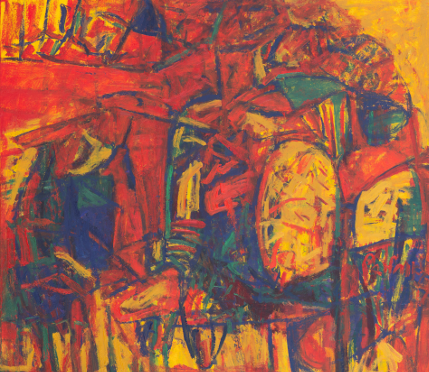
I dwell in the space of seeking—an abstract expressionist by impulse and necessity. Society, to my perception, is no fixed edifice, but a shifting, luminous current—at once elusive and profound. A painting, then, is never still; it breathes, it becomes. I do not arrive at it as an object, but enter it as a living passage. What emerges is not a conclusion, but a continual unfolding—an inner resonance finding its way outward, stroke by stroke, into presence. The diverse actions of human nature, its contradictions, and its subtle sensitivities create an invisible "awakening" within me. This very awakening, this vibration, begins to take shape as a painting. More than what I see, it is what I experience that becomes eager and restless to transform into my colors and forms. Probing my inner self, I often feel that everything is merely an effort. There is a longing for beauty within me, yet I am surrounded by numerous illusions. When I face these illusions, a simple truth emerges—one that is as dense as it is ephemeral. It is this moment, this illusion, that descends onto my canvas. The beauty of nature is not an external sight for me, but an internal stimulation. The countless forms of society around me, its myriad gestures, create an intense "color-desire" within. I make no effort from the outside, for I believe that external conditions are simply the culmination of internal impressions. There is such a deep thirst for time and space within me that it keeps pulling me oward an unknown beauty—as if everything can be transformed, as if even the ordinary can become extraordinary. Life’s journey has been filled with an unknown compassion; perhaps that is why I repeatedly feel as though I possess nothing, and this very emptiness becomes the foundation of my creation. All the expressions of this world are contained within this earth, and their perception is made possible by the consciousness within us. In this moving world, man is a creature who, in the longing to return what he has gained from nature, creates new forms. In this process, he builds his own world out of his desires and emotions. A Shivling, holding the entire world of emotions within itself, is a powerful symbol for me. Similarly, countless geometric forms are present all around us. We only need to look at them with an effortless vision. This is the true beauty of nature. Being a painter is not a desire for material gain or a duty for me; it is a natural state. I need the open sky—that sky which provides a sense of completeness even in the realization of "nothingness." Time, space, air, the sun’s heat, Naad (sound), and countless gazes combine within me in such a way that they transform themselves into a painting. I have come to accept that sensitivity alone cannot lead to perfection. It is the first impulse of creation, but beyond it lie the elements that give a painting its structure and presence. In the beginning, sensitivity appeared to me as a fleeting touch—like a passing breeze. With time and experience, however, I understood that creation does not arise from sensitivity alone; it is shaped equally by structure, foundation, and insight. My study of anatomy becomes a means of entering and absorbing nature more deeply. Form, color, ground, and texture all inhabit my work, yet my notion of form resists definition. Abstraction, for me, is not a deliberate method or experiment—it is the natural condition of imagination. Indeed, imagination itself exists in an abstract state. When I come into friction with the world around me, the sensitivities of human life and their shifting gestures leave a deep imprint within. In the cry of a child, I sense the vibration of an entire world. Inequality renders me momentarily silent before nature. At times, even a passing gust of wind deepens a feeling of detachment—as though nothing here is permanent. The human figure begins to appear fragmented; surfaces of pretense reveal themselves starkly to a searching, unguarded gaze. And then a question returns again and again: why does the world I am shown feel different from the one I perceive? Within this persistent questioning, as illusion slowly dissolves, I came to realize—almost without noticing—that I had become a painter. Time recedes and gathers at the far edge of my work—a quiet horizon I move toward without ever arriving. Beauty does not rest in resolution, but in the charged intensity of making, where each gesture tests the limits of its own becoming. I do not seek the certainty of an object, nor the stillness of form, but a passage into emptiness. And there, in that silent and unclaimed space, where nothing holds and nothing insists, everything begins—fragile,infinite, and alive.


